On this page
Hiring internationally can become complicated very quickly. Different countries have different employment laws, payroll rules, tax requirements, contractor classifications, benefits, and compliance obligations.
Ready to hire globally with less complexity?
See how Deel can help you hire employees and contractors, manage global payroll, handle compliance and support international workforce operations from one platform.
Explore Deel →Deel is designed to bring these areas together in one global HR platform. Businesses can use Deel to hire employees and contractors, manage payroll, handle compliance, onboard workers, and manage HR operations across multiple countries from a single system. Deel says its platform is trusted by more than 40,000 companies. (Deel)
What Is Deel?
Deel is a global HR, payroll, hiring, and workforce-management platform.
It is particularly useful for companies that:
- hire employees in other countries
- work with international contractors
- need Employer of Record services
- run payroll across multiple countries
- want to reduce HR and compliance administration
- manage remote or distributed teams
- want one system for hiring, HR, payroll, and workforce data
One of Deel’s biggest advantages is that companies can hire internationally without necessarily creating their own legal entity in every country. Through its Employer of Record service, Deel can legally employ workers on behalf of the customer while handling payroll, tax, contracts, and local employment requirements. (Deel)
1. Hire Employees Globally Without Setting Up a Local Company
For many businesses, the most powerful Deel feature is its Employer of Record (EOR) service.
Normally, hiring a full-time employee in another country may require establishing a local legal entity, understanding employment laws, registering for taxes, arranging payroll, and complying with local labor regulations.
Deel’s EOR model allows companies to hire international employees through Deel’s infrastructure instead.
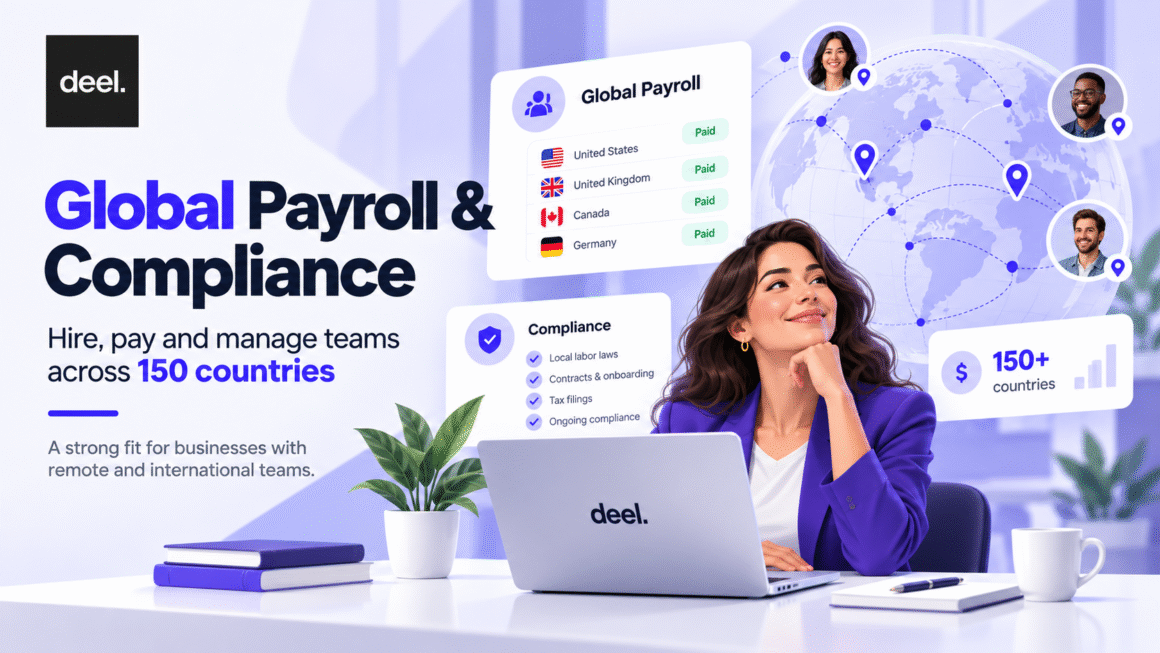
Deel says its EOR service supports global employment across 130+ countries, while its broader compliance and hiring coverage extends across more than 150 countries. (Deel)
The platform can help handle areas such as:
- employment contracts
- onboarding
- payroll
- local taxes
- statutory benefits
- leave and expenses
- minimum wage requirements
- termination procedures
- country-specific employment rules
This can significantly reduce the operational work involved when a company wants to enter a new market or hire specialized talent overseas.
2. Global Payroll from One Dashboard
Companies operating in several countries often use different payroll providers in each market.
That can create fragmented reporting, inconsistent processes, and a large amount of manual administration.
Deel offers a centralized payroll platform where businesses can monitor payroll status, workforce costs, approvals, and payroll data across countries.
Companies can choose between self-service and managed payroll, depending on the country and their requirements. Deel also supports bringing employees, contractors, EOR workers, PEO workers, and third-party payroll data into one system. (Deel)
Another useful feature is consolidated reporting. Instead of checking separate systems country by country, HR and finance teams can see payroll information from a central dashboard.
3. International Contractor Management
Many modern companies use freelancers and contractors around the world.
Deel provides tools for managing international contractors, including contracts, invoices, approvals, payments, and compliance.
Its contractor platform supports payments across 200+ countries and jurisdictions and more than 120 currencies. (Deel)
Businesses can manage contractor payments in bulk instead of transferring money individually to each worker.
Deel also supports multiple payout methods for contractors, including local currency options and selected third-party payment providers. (Deel)
4. Contractor of Record and Misclassification Protection
One major risk when hiring international contractors is worker misclassification.
A company may call someone a contractor, but local employment authorities may legally consider that person an employee.
That can create tax, employment, and compliance problems.
Deel offers a Contractor of Record service designed to reduce this risk. Deel can act as the contracting entity and take on classification-related responsibilities while providing localized agreements and compliance support. (Deel)
This can be particularly valuable for companies that work with large international contractor teams.
5. Built-In Global Compliance
Employment regulations change frequently.
Minimum wages, tax rules, benefits, contractor classifications, employment documentation, and reporting requirements can vary considerably between countries.
Deel includes compliance tools that monitor regulatory changes and compare workforce information with local rules.
Its compliance platform can:
- monitor regulatory updates
- identify potential compliance risks
- alert teams about upcoming changes
- analyze worker classification
- maintain compliance-related records
- centralize compliance information across countries
Deel also offers an AI-powered worker classification tool and a centralized compliance knowledge hub. (Deel)
6. Complete HR Management
Deel has expanded beyond payroll and EOR into a broader HR platform.
Businesses can manage employee information, organizational structures, leave, approvals, workforce planning, recruiting, onboarding, and payroll from the same ecosystem. (Deel)
A worker profile can connect information used across HR and payroll rather than maintaining separate databases for different departments.
This can be particularly useful for growing companies that want fewer disconnected HR tools.
7. Recruiting and Applicant Tracking
Deel also provides recruiting and applicant-tracking functionality.
The platform supports:
- job posting
- candidate pipelines
- AI-assisted screening
- interview scheduling
- interview summaries
- offer generation
- candidate management
- onboarding
Businesses can move candidates from recruitment into employment workflows without manually transferring information between several systems. (Deel)
8. Hire Contractors and Employees from the Same Platform
One useful advantage of Deel is that a company does not need completely different systems for employees and contractors.
A business can manage:
Direct employees
International EOR employees
US PEO employees
Independent contractors
Contractor of Record workers
from the broader Deel ecosystem.
This can make workforce reporting and administration easier for businesses with mixed employment models.
Ready to hire globally with less complexity?
See how Deel can help you hire employees and contractors, manage global payroll, handle compliance and support international workforce operations from one platform.
Explore Deel →9. International Payments
Paying workers internationally can involve currency conversion, international transfers, banking restrictions, and separate payment processes.
Deel centralizes international workforce payments.
For contractors, companies can approve earnings and expenses and then make a bulk payment through Deel rather than manually sending payments individually. (Deel)
Workers can then access available payout methods supported in their location.
10. AI Features
Deel is increasingly adding AI across the platform.
Its AI capabilities can assist with areas such as:
- candidate screening
- interview summaries
- HR questions
- compliance information
- workforce insights
- employee support
- worker classification
Deel AI is integrated with HR and workforce information and is designed to provide answers based on HR and compliance knowledge. (Deel)
11. Device and IT Management
International hiring creates another problem: getting laptops, applications, and secure access to employees located around the world.
Deel also provides IT and device-management capabilities.
Businesses can provision devices, manage application access, and support employee onboarding and offboarding across international teams. Deel says devices and access can be managed across the worker lifecycle in more than 130 countries. (Deel)
This is particularly useful for remote-first companies.
12. Integrations With Existing Business Software
Companies do not necessarily need to replace all their existing software when adopting Deel.
The platform supports integrations with HR, payroll, accounting, productivity, and other business systems.
Deel also provides APIs for businesses that want to connect global hiring and payroll functionality to their own software or internal workflows. (Deel)
Deel Pricing in 2026
Pricing varies by product.
Current listed starting prices include:
| Deel Service | Starting Price |
|---|---|
| Talent / recruiting | $14 per worker/month |
| Contractor management | $49 per contractor/month |
| Contractor of Record | $325 per contractor/month |
| Employer of Record | $599 per employee/month |
| US PEO | $125 per employee/month |
Pricing and availability can vary by location, product, and business requirements, so businesses should confirm the current price directly with Deel before purchasing. (Deel)
Who Should Consider Deel?
Deel is particularly relevant for:
Startups expanding internationally
A startup can hire talent abroad without immediately establishing companies in every new country.
Remote-first companies
Businesses with employees and contractors spread around the world can manage them from a centralized platform.
Recruitment and staffing businesses
Companies placing international workers can use Deel for employment, payroll, and compliance infrastructure.
Growing companies entering new markets
Deel can reduce some of the administrative barriers involved with international expansion.
Companies with many international contractors
Centralized contracts, classification, payments, and compliance can be useful when managing large contractor networks.
Major Advantages of Deel
The strongest benefits are its combination of international hiring, payroll, contractor management, compliance, HR, recruiting, payments, and IT capabilities inside one ecosystem.
Instead of combining numerous separate services for each country, companies can centralize more of their workforce operations.
The platform is especially useful when international expansion is happening quickly and the company does not want to establish legal entities immediately in every market.
Things to Consider Before Choosing Deel
Deel is a broad professional platform, but that does not automatically mean every company needs every Deel service.
Small companies hiring only locally may not need an EOR or global payroll platform.
Companies should also calculate the cost of EOR or Contractor of Record services against the cost of creating and managing their own local entity.
Pricing can also increase significantly when a business manages a large international workforce.
For this reason, businesses should compare the required services rather than purchasing features they do not actually need.
Final Thoughts
Deel has developed from an international contractor payment platform into a much broader global workforce system.
Its strongest capability is bringing together areas that normally require multiple providers:
Hiring → Contracts → Compliance → Payroll → Payments → HR → Recruiting → IT
For companies building international or remote teams, having these services connected can reduce administrative complexity and make international hiring easier to manage.
Businesses should still review local legal requirements, pricing, and the exact Deel service they need before making a decision.

Ready to hire globally with less complexity?
See how Deel can help you hire employees and contractors, manage global payroll, handle compliance and support international workforce operations from one platform.
Explore Deel →